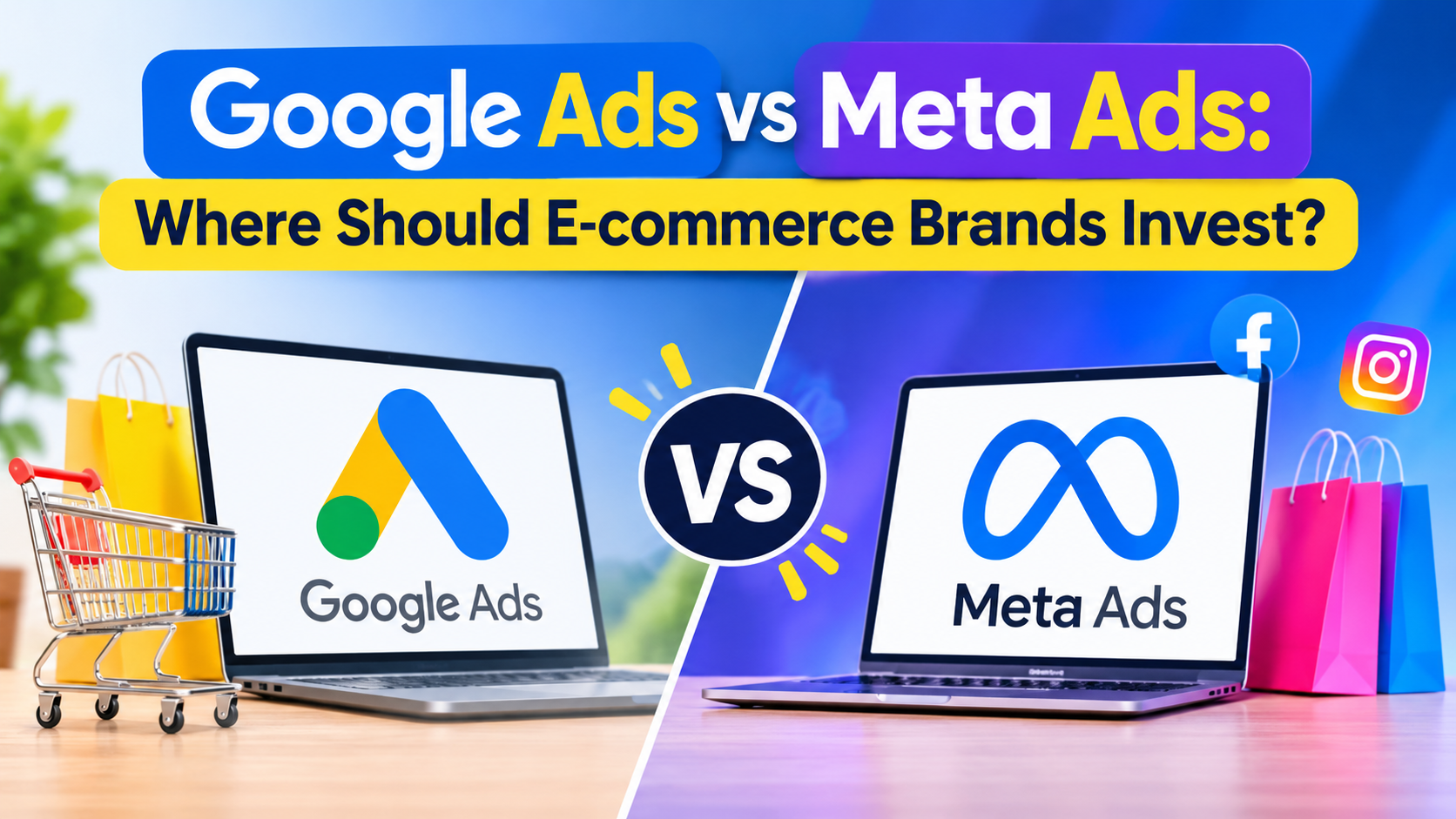
Choosing the right advertising platform can make a big difference to your e-commerce sales. Google Ads and Meta Ads are two of the most popular options for online stores. Both can help you reach new customers, increase website traffic and grow revenue. However, they work differently.
Google Ads helps you reach people who are already searching for products. Meta Ads helps you introduce your products to people while they browse Facebook and Instagram. So, which platform should your e-commerce business invest in? The answer depends on your products, target audience, budget and business goals. This article compares Google Ads vs Meta Ads, explains their main differences and shows you how to choose the right platform for your online store.
What Are Google Ads?
Google Ads is an online advertising platform that allows businesses to promote products and services across Google's network. These ads can appear in Google Search results, Shopping listings, YouTube videos and other partner websites. For e-commerce brands, Google Ads is particularly useful because it reaches people who are already looking for specific products.
For example, someone searching for "buy running shoes online" may see shopping or search ads from relevant retailers. This means your brand can reach potential customers when they are closer to making a purchase.
Key benefits of Google Ads for e-commerce include:
High purchase intent: Reach shoppers who are actively searching for products.
Shopping campaigns: Display product images, prices and store information in search results.
Keyword targeting: Target searches related to your products and categories.
Flexible budgets: Set daily budgets and adjust bids based on performance.
Measurable results: Track clicks, conversions, sales, and return on ad spend.
Google Ads works particularly well for products with existing search demand. It can help your store capture customers who already know what they want to buy.
What Are Meta Ads?
Meta Ads is an advertising platform that lets businesses promote products across Facebook, Instagram, Messenger, and other placements available through Meta. Unlike Google Ads, Meta Ads does not rely mainly on people searching for products. Instead, it helps brands reach potential customers based on their interests, behaviours and other available audience signals.
For example, an online clothing store can show stylish outfits to people who may be interested in fashion, even if they are not actively searching for new clothes.
Key benefits of Meta Ads for e-commerce include:
Audience targeting: Reach people based on interests, behaviours and other targeting signals.
Visual advertising: Use images, videos, carousels and Reels to showcase products.
Brand awareness: Introduce your products to people who have not discovered your store.
Retargeting: Re-engage people who have visited your website or interacted with your brand.
Product discovery: Help shoppers discover products they may not have searched for.
Meta Ads is especially useful for visually appealing products, such as clothing, beauty products, home décor and lifestyle accessories. It can also support impulse purchases by showing customers products that match their interests.
Google Ads vs Meta Ads: Key Differences
Both platforms can drive ecommerce sales, but their approaches are different. Understanding these differences will help you decide where to invest your advertising budget.
| Feature | Google Ads | Meta Ads |
|---|---|---|
| Primary Approach | Search intent-based advertising | Audience discovery-based advertising |
| Campaign Objectives | Flexible campaign setup with optional objectives | Objective-driven campaign structure |
| Ad Placements | Google Search, YouTube, Display Network, Gmail, Discover, Maps, and Shopping | Facebook, Instagram, Messenger, and Audience Network |
| Audience Targeting | Keywords, in-market audiences, affinity audiences, and Customer Match | Demographics, interests, behaviors, Custom Audiences, and Lookalike Audiences |
| User Intent | Targets users actively searching for products | Reaches users based on interests, behavior, and predicted needs |
| Creative Strategy | Focuses on relevant keywords, ad copy, images, and videos | Focuses on visual storytelling, engaging images, videos, and Reels |
| Ad Formats | Search, Display, Shopping, Video, and Performance Max ads | Image, carousel, video, collection, Stories, and Reels ads |
| Algorithm & Learning | Uses search intent, conversion signals, and Smart Bidding | Uses engagement patterns, audience behavior, and machine learning |
| Cost Structure | Commonly uses CPC, CPM, and automated bidding models | Commonly uses CPM-based auction delivery and cost-per-result optimization |
| Attribution & Tracking | Uses Google tags, Google Tag Manager, and enhanced conversions | Uses Meta Pixel and Conversions API (CAPI) |
| Reporting & Analytics | Integrates with GA4, Tag Manager, and Looker Studio | Uses Meta Ads Manager and in-platform performance reporting |
| Automation | Smart Bidding and Performance Max | Advantage+ campaigns |
| Best For | Capturing high-intent traffic and driving direct conversions | Building brand awareness, audience engagement, and product discovery |
| Scalability | Scales through keywords, conversion data, and automated bidding | Scales through creative testing, audience learning, and automated campaigns |
Neither platform is automatically better for every e-commerce business.
Google may deliver stronger results when customers already search for your products. Meta may be more useful when your products need visual promotion or when you want to introduce your brand to new audiences.
When Should E-commerce Brands Invest in Google Ads?
Google Ads can be a good starting point when customers are already searching for your products.
Consider investing in Google Ads if:
People regularly search for the products you sell.
Your products meet clear customer needs.
You want to capture shoppers with strong purchase intent.
Your product prices and availability are competitive.
Your store has well-optimised product pages.
For example, an electronics store selling laptops, monitors and headphones can benefit from Google Shopping campaigns. Shoppers often compare prices and product features before making a purchase.
Google Ads can help your products appear during this decision-making process.
However, you should not rely on paid traffic alone. Your product pages, pricing, reviews and checkout experience must give shoppers a reason to buy.
If you want to get more sales through Google, explore Pear Digital's Google Ads management services.
When Should E-commerce Brands Invest in Meta Ads?
Meta Ads can be a better choice when your products need visual promotion, or customers may not know your brand exists.
Consider investing in Meta Ads if:
Your products look attractive in images or videos.
You are introducing a new product.
You want to build brand awareness.
Your audience spends time on Facebook and Instagram.
You have strong creative content to test.
For example, a clothing brand can use Instagram Reels to showcase new outfits. A beauty brand can create short videos showing how its products fit into a skincare routine.
These adverts can attract attention and encourage people to visit your store.
Meta Ads can also support repeat sales by reaching previous website visitors and customers, subject to available tracking and audience rules.
Pear Digital also provides e-commerce Meta Ads services to help online stores reach more people and increase sales.
Should You Use Google Ads and Meta Ads Together?
Often, yes. Meta can introduce your brand to new customers, while Google can capture later searches when they are closer to buying. Both platforms can also support retargeting.
However, do not split a small budget too early. Start with the channel that addresses your biggest growth problem, then add the second once your offer, tracking and conversion data are reliable enough to guide decisions.
You can support your ad campaigns with email marketing. For example, Klaviyo can help you follow up with customers, recover abandoned carts and encourage repeat purchases.
Learn more about Pear Digital's Klaviyo email marketing services to improve your email marketing.
Google Ads vs Meta Ads: Which Costs Less?
The cost of advertising on Google and Meta depends on several factors. Both platforms use auctions, so costs change depending on competition, audience, location, campaign objective, ad quality and the value of the customers you are trying to reach.
You may see a lower cost per click on one platform but generate more profitable sales on the other. Cheap traffic is not the same as efficient advertising.
When comparing Google Ads and Meta Ads, look beyond clicks and impressions. Track:
Cost per acquisition (CPA): The amount spent to secure a single customer purchase.
Customer acquisition cost (CAC): The total marketing expense involved in bringing a new customer to your business.
Conversion rate: The percentage of website visitors who complete a purchase.
Return on ad spend (ROAS): The revenue earned for every pound invested in advertising.
Average order value (AOV): The average revenue generated from each customer order.
Profit margin: The money left after covering product expenses, delivery, marketing and other operating costs.
For example, Meta may generate a large volume of inexpensive traffic, while Google may bring fewer visitors with stronger purchase intent. The better platform is the one that helps you acquire customers at a cost your margins can support.
Common Mistakes E-commerce Brands Should Avoid
Even a well-planned advertising campaign can struggle if your store or marketing strategy has problems. Here are common mistakes to watch out for:
Choose the Wrong Platform: Investing heavily in Google for a product that has zero search volume, or using Meta for a boring commodity product.
Poorly Optimised Product Pages: Even the best ads won't convert if your Shopify site is slow or confusing.
Ignoring Mobile Users: Most Meta users are on mobile devices with varying network speeds. Your site must be lightning-fast.
Focusing Only on ROAS: ROAS is important, but it doesn't tell the whole story of brand growth or customer loyalty.
Stopping Too Early: Ad platforms need time to learn. Google’s Smart Bidding and Meta’s AI require data to find your best customers.
A Simple Way to Choose Your First Platform
Before investing in Google Ads or Meta Ads, ask yourself these five questions:
Are people already searching for my product? If yes, test Google Ads first.
Does the product need to be seen to be understood? If yes, test Meta Ads first.
Can I explain the product in a search ad and product listing? If yes, Google may be a strong fit.
Can I create fresh images and videos consistently? If yes, Meta may give you more room to grow.
What can I afford to pay for a new customer? Use this figure to judge both platforms.
Do not choose a channel because another brand uses it successfully. Select the platform that aligns with how your customers find products, evaluate their options and make buying decisions.
FAQs
1. Is Google Ads better than Meta Ads for e-commerce?
Both platforms can work well for e-commerce businesses. Google Ads helps you reach people who are already looking for products, while Meta Ads helps you introduce your products to new customers and build brand awareness. The best choice depends on your products, audience and business goals.
2. Which platform is cheaper, Google Ads or Meta Ads?
Costs vary based on your industry, audience, competition and campaign quality. Meta Ads may offer affordable reach, while Google Ads can cost more for competitive keywords. However, the cheapest clicks do not always produce the best sales.
3. Can small e-commerce businesses use Google Ads and Meta Ads?
Yes. Small businesses can start with modest budgets on both platforms. Focus on a small number of products, test different campaigns and track conversions before increasing your spending.
4. Should I run Google Ads and Meta Ads at the same time?
Yes, if your budget allows it. Running both platforms can help you reach customers at different stages of their buying journey. Meta Ads can build awareness, while Google Ads can capture existing purchase demand.
5. How long does it take to see results from Google Ads and Meta Ads?
You may see traffic and early conversions shortly after launching campaigns. However, consistent, profitable results take time. Allow enough time and budget to collect useful data, test different approaches and optimise your campaigns.
Conclusion: Google Ads vs Meta Ads – Where Should You Invest?
Google Ads and Meta Ads can both deliver excellent results for e-commerce businesses, but they serve different purposes. Google Ads is a strong choice for capturing existing demand and reaching shoppers who are actively searching for products. Meta Ads is better suited to product discovery, visual promotion and building brand awareness.
For most growing e-commerce brands, combining both platforms can create a stronger advertising strategy. Use Meta Ads to introduce your products to new audiences and Google Ads to capture high-intent searches. Start by testing both platforms, tracking profitable conversions and adjusting your budget based on real results.
Ready to Scale Your E-commerce Brand?
Stop guessing and start growing. At Pear Digital, we help businesses grow through high-converting Shopify stores, effective Google Ads campaigns and strategic email marketing. We help you reach more customers, increase sales, and get better results from your marketing budget.
Book a free consultation with Pear Digital and start building an advertising plan around your goals.